Advective Zigzag Micromixer
Rapid phase contact and chaotic advection for lipid nanoparticle (LNP) formulation and solvent-exchange workflows.
| Material | 3D printed polymer (monolithic) |
| Method | Monolithic high-resolution 3D printing (no bonded layers or adhesives) |
| Min feature | 300 µm channel width |
| Idea to tested device | 3 days |
THE WORKFLOW
Formulating lipid nanoparticles, liposomes, and nano-emulsions requires rapid, uniform mixing between an aqueous buffer and solvent-dissolved lipids. At microfluidic scales, laminar flow prevents spontaneous mixing; inducing rapid chaotic advection across high flow rate ratios is essential to achieve narrow particle size distributions before precipitation occurs.
HOW IT WAS BUILT
A fully monolithic 3D-printed microfluidic chip with a 300 µm internal serpentine zigzag channel. Because channels and fluidic ports are printed as a single contiguous solid, there are zero bonded layers, seams, or adhesives. This avoids interfacial delamination under high fluidic pressures and allows complex 3D internal routing to be fabricated and tested in days.
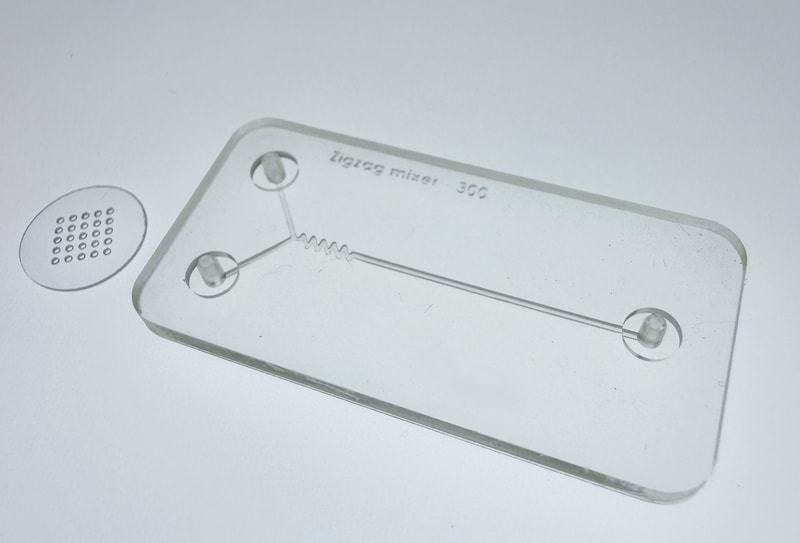 Monolithic 3D-printed transparent chip showing integrated fluidic ports and the 300 µm serpentine mixing channel.
BENCH CHARACTERIZATION
Evaluated under continuous flow up to 1,800 µL/min Total Flow Rate (TFR). Live microscopy confirms that the planar alternating turns induce robust advective secondary flows, achieving complete visual dye homogenization within the first three turns without pressure failure, port leakage, or channel deformation.
HOW THIS APPLIES TO YOUR DEVICE
If you are formulating lipid nanoparticles (LNPs), liposomes, or polymers, you do not have to lock yourself into expensive, fixed-geometry commercial glass chips. I tailor internal channel widths, aspect ratios, and turn counts to match your specific solvent-to-aqueous flow ratios, viscosity differences, and target particle size distributions. Because the devices are printed as seamless monolithic parts, you get leak-free fluidic routing with integrated ports.